A következő címkéjű bejegyzések mutatása: Canada. Összes bejegyzés megjelenítése

2012. június 27., szerda

Thetford Mines

This town is the hometown from Karin (Canada). I got the card through FB-swap.
(Received in June, 2012)


Thetford Mines  is a town in south-central Quebec, Canada. It is the seat of Les Appalaches Regional County Municipality.
Thetford Mines was founded in 1876 after the discovery of large asbestos deposits in the area, and the city became a hub for one of the world's largest asbestos-producing regions. In 2001 the city expanded to its current boundaries, merging with Black Lake, Robertsonville, Pontbriand and Thetford-Sud.
Thetford Mines is the seat of the judicial district of Frontenac.


Newfoundland

I got this postcard also from Karine (Canada), through FB-swap.
(Received in June, 2012)


Newfoundland and Labrador is the easternmost province of Canada. Situated in the country's Atlantic region, it incorporates the island of Newfoundland and mainland Labrador (located Northwest of the island) with a combined area of 405,212 square kilometres (156,500 sq mi). Newfoundland and Labrador's capital and largest city, St. John's, is Canada's 20th-largest Census Metropolitan Area, and is home to nearly 40 percent of the province's population. St. John's is the seat of government, home to the House of Assembly of Newfoundland and Labrador and the highest court in the jurisdiction, the Newfoundland and Labrador Court of Appeal.
A former colony and dominion of the United Kingdom, Newfoundland and Labrador became the tenth province to enter the Canadian Confederation on March 31, 1949, as Newfoundland. On December 6, 2001, an amendment was made to the Constitution of Canada to change the province's official name to Newfoundland and Labrador. In day-to-day conversation, however, Canadians generally still refer to the province itself as Newfoundland and to the region on the Canadian mainland as Labrador.

Québec

These two postcard are from Karine (Canada) through FB-swap.
(Received in June, 2012)


Quebec (Québec), also Québec, Quebec City or Québec City (Ville de Québec) is the capital of the Canadian province of Quebec. As of 2011, the city has a population of 516,622, and the metropolitan area has a population of 765,706, making it the second most populous city in Quebec after Montreal, which is about 233 kilometres (145 mi) to the southwest.
According to the federal and provincial governments, Québec is the city's official name in both French and English, although Quebec City (Ville de Québec) is commonly used, particularly to distinguish the city from the province. The city's most famous landmark is the Château Frontenac, a hotel which dominates the skyline. The National Assembly of Quebec, the Musée national des beaux-arts du Québec (National Gallery of Quebec), and the Musée de la civilisation (Museum of Civilization) are found within or near Vieux-Québec.

Canada

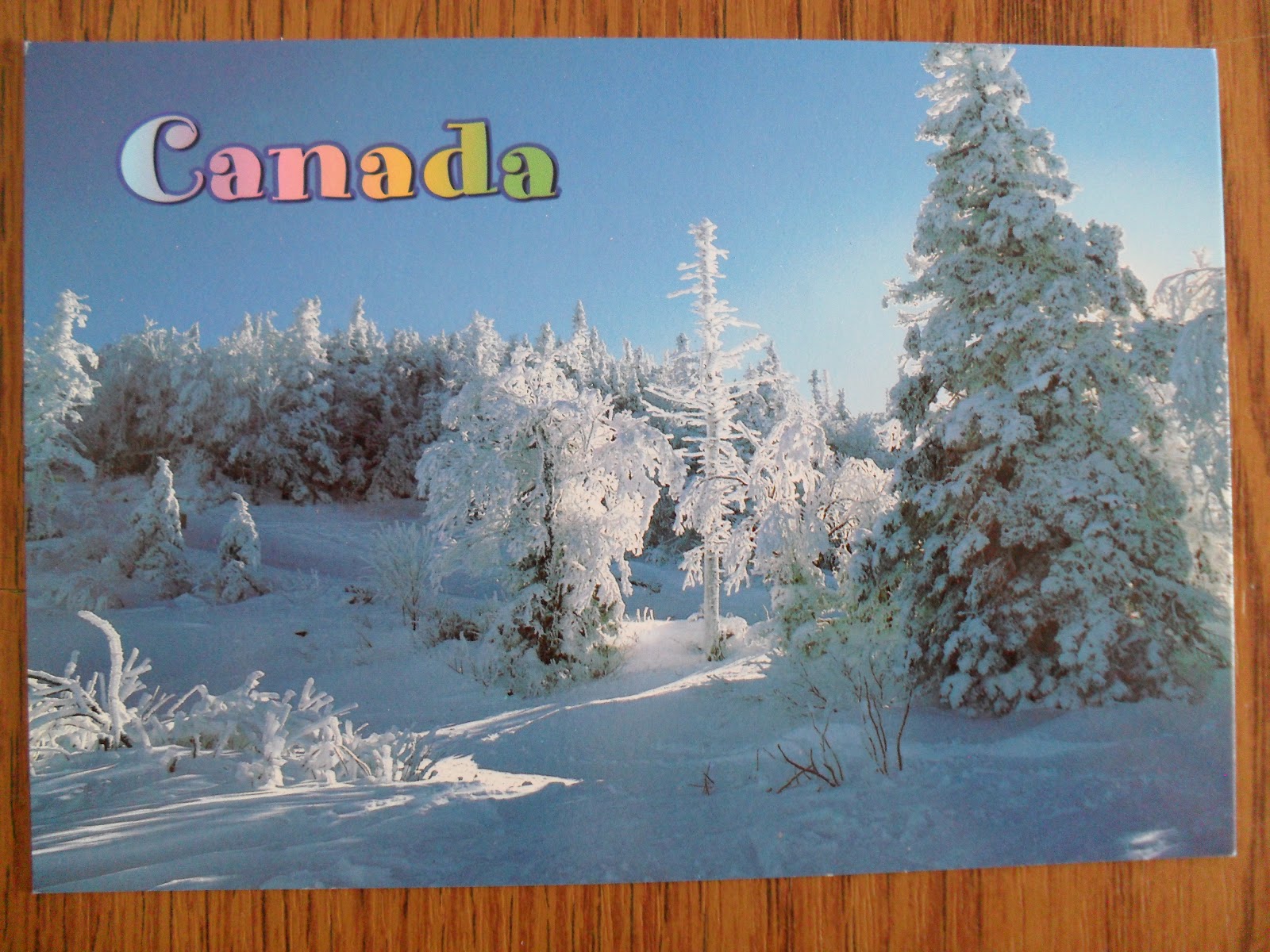
This beautiful snowy winter-postcard is from Karine (Canada), through FB-swap.
(Received in June, 2012)


Canada is a North American country consisting of ten provinces and three territories. Located in the northern part of the continent, it extends from the Atlantic Ocean in the east to the Pacific Ocean in the west, and northward into the Arctic Ocean. Canada is the world's second-largest country by total area, and its common border with the United States is the world's longest land border.
The land that is now Canada has been inhabited for millennia by various Aboriginal peoples. Beginning in the late 15th century, British and French colonial expeditions explored, and later settled, the region's Atlantic coast. France ceded nearly all of its colonies in North America in 1763 after the Seven Years' War. In 1867, with the union of three British North American colonies through Confederation, Canada was formed as a federal dominion of four provinces. This began an accretion of provinces and territories and a process of increasing autonomy, culminating in the Canada Act 1982.
Canada is a federal state governed as a parliamentary democracy and a constitutional monarchy, with Queen Elizabeth II as its head of state. The country is officially bilingual at the federal level. 

2012. június 25., hétfő

Saskatchewan

This card is from my penpal, Morgan, from Canada.
(Received in March, 2012)


Saskatchewan is a prairie province in Canada, which has an area of 588,276 square kilometres (227,100 sq mi). Saskatchewan is bordered on the west by Alberta, on the north by the Northwest Territories, on the east by Manitoba, and on the south by the U.S. states of Montana and North Dakota.
Other major cities include Prince Albert, Moose Jaw, Yorkton, Swift Current and North Battleford.